• Welcome to the new Macedonian Truth Forum. All posts, members and private messages have been moved over from the old forum.

    Passwords from the old forum could not be carried over, so please use Forgot your password? to set a new one. The reset link is emailed to the address on your account.

  • Rules and Regulations at the forum of the Macedonian Truth Organisation (MTO)

    (1) The national-ethnic and cultural-linguistic identity of the Macedonian people is historically Macedonian, and derives its character from the native, indigenous and geographic homeland of the Macedonians, which is called Macedonia. To ensure that their human rights, integrity and heritage are appropriately respected, the only nouns and adjectives acceptable when reference is made to the above character and identity markers is Macedon, Macedonia, Macedonian and Macedonians.

    (2) The nation-state of the Macedonian people is the Republic of Macedonia, and is to be referred to by this official title so long as the 'republic' prefix is consistently applied to other states. Alternative references are the Macedonian Republic, or simply, Macedonia.

    (3) The 'ethnic' prefix is only acceptable for Macedonians in cases where differentiation is specifically required - so long as it is in context and consistent where it concerns its application to other ethnic groups.

    (4) Should any other differentiation be specifically required, the names of other ethnic groups that reside with Macedonians in either the Republic of Macedonia or the occupied Macedonian regions in Greece, Bulgaria, Serbia or Albania, are to be given a prefix.

    (5) Negating the identity, language and culture of the Macedonian people by deliberate avoidance of the terms Macedonia, Macedonian and Macedonians, or by any other means, is not permitted.

    (6) Systematic anti-Macedonian propaganda and rhetoric are not permitted.

    (7) Threads irrelevant to the Macedonian Cause, the community at the Macedonian Truth Organisation or the Macedonians in general may be considered as spam or not in the spirit of the forum. In such cases they are not permitted.

    (8) Continual posting of messages in threads with the sole purpose of deviating from the initial topics with the use of unrelated and unnecessary information is not permitted.

    (9) All posts, external articles, reports, etc that are cited in languages other than Macedonian or English, must be accompanied with a translation in one or both of the said languages.

    (10) Despite the possibility of some conversations and debates becoming heated, extreme abuse and/or racism, vulgar language and/or terminology, threats, revelation of personal information about others, harassment, and other such behavior will not be permitted. If deemed necessary all relevant information including member details will be reported to the appropriate authorities for investigation which may result in legal action.

    (11) Threads that are created must have a summary of a topic or excerpt of an article found in pertinent link(s) that have been included. One line threads will be considered unaccetable spam and are therefore not permitted.

    (12) Compulsive and deliberate lies, irrespective of the topic, are not permitted.

    (13) Any symbols or avatars found to be perceived as offensive to Macedonians are not permitted.

    (13) Any explicit or extreme material is not permitted.

    Failure to adhere to the above rules and regulations will result in a ban after 3 breaches. This may be reconsidered in some cases should the circumstances be of an unorthodox nature and/or require special consideration. To assure an effective deterrent against an individual or individuals with the sole purpose of causing dissent through spamming, racism or other improper means, the above rules will be strictly enforced.

    The MTO administration will monitor all discussions as reasonably practical and reserve the right to remove any post and/or member from the forum, and update the rules and regulations as required. Members are encouraged to immediately report any post and/or member to the MTO administration if they feel that these rules have not been abided by.

    The views expressed on this forum are those of the individuals. The only official representation of the MTO is made by the "Macedonian Truth Organisation (Site Owner)" username, and no other.

  • Macedonian Cause

    The Macedonian Truth Organisation calls on God in Heaven to protect, bless and guide the endeavour it is committing to undertake, and that is to work towards:

    Securing Macedonia as a free, independent and democratic republic in which sovereignty lies with the Macedonian citizens; as the nation-state of the Macedonian people in which they can preserve their culture, language and identity; as a state in which the Macedonian language and culture form the basis of public life and act as important unifying elements of Macedonian society; as the home of all its citizens to which it guarantees and obliges their inalienable natural rights and corresponding responsibilities;

    The acknowledgment as self-evident and irrefutable the existence of the:

    1) Indigenous, ethnonational name of Macedonia;
    2) Macedonian people, language and identity;
    3) Macedonian culture, symbols and folklore;
    4) Macedonian ancestry, heritage and history in its entirety; and
    5) Macedonian Orthodox Church;

    Securing recognition by the International Community of the tragedies endured by the Macedonian people, of the division of Macedonia with the signing of the Treaty of Bucharest on August 10, 1913, and the genocide committed against the Macedonian people at the hands of the Greek, Bulgarian and Serbian states and their respective churches during the 19th and 20th centuries;

    Ensuring that the Interim Accord is declared ‘null and void’ and that all constitutional provisions, acts, commitments, agreements, legislation, regulations, policies or programs emanating from, supporting or consequential to the Interim Accord are also declared ‘null and void’, including the use of any symbols and the completion of any acts imposed by, or originating from, the Interim Accord.

    Ensuring that the Framework Agreement is abolished and that all constitutional provisions, acts, commitments, agreements, legislation, regulations, policies and programs emanating from, supporting or consequential to the Framework Agreement are also abolished and replaced by a framework of constitutional and statutory law based on inalienable natural rights and corresponding responsibilities and universally codified human rights mechanisms.

    Securing the abolishment of any existing constitutional provisions, acts, agreements, legislation, regulations, policies and programs that discriminate against the Macedonian people, in any international organisation or any of the countries of the International Community where such constitutional provisions, acts, agreements, legislation, regulations, policies and programs exist, and thereby ensuring the freedom for Macedonians to exercise their inalienable natural rights and fulfil their corresponding responsibilities, and practice their culture, language and religious faiths in all the countries of the International Community without hindrance;

    The empowerment of Macedonians to undertake a moral revolution and to instil and/or reinvigorate within themselves a deep-rooted national, cultural, linguistic and historical dignity and a commitment to the exercise of freedom based on inalienable natural rights and corresponding responsibilities;

    The recognition of the Macedonian minorities in the neighbouring states of Macedonia as well as the respect for the inalienable rights and freedoms of the Macedonian minorities, as provided for by natural law and as codified by the United Nations Charter, the Universal Declaration of Human Rights and other universally codified human rights mechanisms;

    The full and unreserved respect of, and the support for, the rights of all people of non-Macedonian descent living in Macedonia and around the world, who share a reciprocal full and unreserved respect for the Macedonian people, their homeland and their state;

    The cultural unification and solidarity of the Macedonian people living in all parts of historical Macedonia and adjacent territories, as well as Macedonians throughout the world;

    The unity of all Macedonians on the principles, objectives and achievement of the Macedonian cause as defined by this declaration.

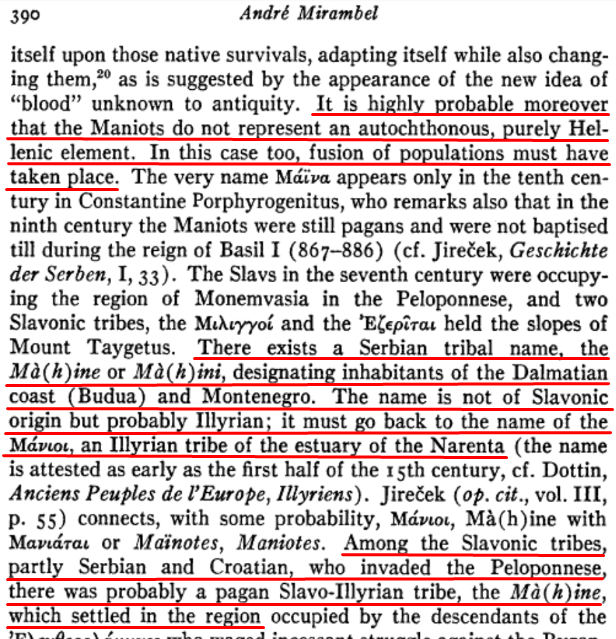
The Real Ethnic Composition of Modern Greece

JOURNAL ARTICLE
BLOOD VENGEANCE ("MAINA") IN SOUTHERN GREECE AND AMONG THE SLAVS
André Mirambel
Byzantion
Vol. 16, No. 2 (1942-1943), pp. 381-392
Published by: Peeters Publishers

u36oFcX.png
 
Which manner is that?
The text in your link stated the following:
......the words "Vlachs", "Arvanites" and "Arvanitovlachoi" had an indefinite meaning and were used by the people in the sense of nomadic cattle breeders.
The question remains. Are there any sources from that period that suggest terms like Arvanites and Arvanitovlachs had an indefinite meaning (generic, non-ethnic) and were used by people in the sense of nomadic cattle breeders? The text seems to be drawing an analogy of the terms Arvanites and Arvanitovlachs with the term Vlach. The last term (Vlach) may have been used in such a manner (in certain contexts), meaning in some cases it generically referred to a shepherd or something similar. What about Arvanites and Arvanitovlachs? Were there non-Albanians in Greece called Arvanites simply for being a cattle breeder?

On a side note, the text also has a link within it regarding the town of Pallini in Attica.
Θέση της σύγχρονης πόλης αποτελεί το ιστορικό κέντρο του αρβανίτικου οικισμού Χαρβάτι. Ανήκει στην Περιφερειακή Ενότητα Ανατολικής Αττικής της Περιφέρειας Αττικής.

Location of the modern city is the historical center of the Albanian settlement Harvati. It belongs to the Regional Unit of East Attica of the Attica Region.
Interesting toponym. I note that the modern Greek word for Croatians is Kroates (Κροάτες). However, in the Middle Ages, it was Hrovatoi (Χρωβάτοι). Might be just a coincidence, but it looks very similar to Harvati (Χαρβάτι) post-metathesis ar > ra.

By the way, is Pallini a Greek toponym? Seems to be a common surname in Italian.
 
The text in your link stated the following:

The question remains. Are there any sources from that period that suggest terms like Arvanites and Arvanitovlachs had an indefinite meaning (generic, non-ethnic) and were used by people in the sense of nomadic cattle breeders? The text seems to be drawing an analogy of the terms Arvanites and Arvanitovlachs with the term Vlach. The last term (Vlach) may have been used in such a manner (in certain contexts), meaning in some cases it generically referred to a shepherd or something similar. What about Arvanites and Arvanitovlachs? Were there non-Albanians in Greece called Arvanites simply for being a cattle breeder?

Not exactly but this has been often discussed in the forum, how Arvanitovlachs (i.e. Vlachs from Albania) have fused with Albanians at some occasions or how various Greeks or foreigners confuse them or put them in the same sentence.
 
On a side note, the text also has a link within it regarding the town of Pallini in Attica.

Interesting toponym. I note that the modern Greek word for Croatians is Kroates (Κροάτες). However, in the Middle Ages, it was Hrovatoi (Χρωβάτοι). Might be just a coincidence, but it looks very similar to Harvati (Χαρβάτι) post-metathesis ar > ra.

By the way, is Pallini is a Greek toponym? Seems to be a common surname in Italian.

The etymology of Harvati (that also appears in 4-5 minor toponyms) is unknown. Here, an Arvanite provides an analysis, his theory is that it is related to Arvanites, but comes from the (recent Greek) word harvalon (ruin).

https://translate.google.com/translate?sl=auto&tl=en&u=https%3A%2F%2Farvanitika.blogspot.com%2F2014%2F11%2Fblog-post_24.html


Pallene is an ancient Greek name
https://en.wikipedia.org/wiki/Pallene_(Attica)


---------------------------------------------
 
Last edited:
Not exactly but this has been often discussed in the forum, how Arvanitovlachs (i.e. Vlachs from Albania) have fused with Albanians at some occasions or how various Greeks or foreigners confuse them or put them in the same sentence.
The intermixing of peoples and confusion on the part of others is probable. The likelihood of the term Arvanites being used to refer to any cattle breeder, irrespective of their ancestral background, doesn't seem to be so, at least not in the wholesale way it was described in the text.
The etymology of Harvati (that also appears in 4-5 minor toponyms) is unknown. Here, an Arvanite provides an analysis, his theory is that it is related to Arvanites, but comes from the (recent Greek) word harvalon (ruin).

https://translate.google.com/transla...g-post_24.html
Damn, that is one self-hating Tosk Albanian. I am going to ignore most of his nonsense and just cite some of the text from the link:
The place name is definitely Arvanite, because the first inhabitants of Harvatio (today's Pallini) were Arvanites. We also find it outside (3 km east) of Loutraki (as a settlement and stream) and Mycenae (the old name of the homonymous village) , areas also with Arvanites. It is also found as a mountain near the Stratos of Etoloakarnania, an area from the first Arvanites who moved and today Arvanitovlachs ( Palaiomanina ) flourish.
So, according to him, it is found in Attica, Aetolia-Acarnania and the Peloponnese.
But we have other place names in Arvanitika that end in -ati (like Strati ).
Strati is an Albanian place name? Interesting theory. Do you believe that? Or do you think Strati is the Greek short form or colloquial way of saying Stratis?
The name Harvati, therefore, has to do with a geographical characterization, a special peculiarity related to the soil and its curves or possibly with some features of flora. It seems difficult to know exactly, as in many other cases of Arvanite toponyms. , that the physiognomy of the area is captured, but we can not first identify the exact meaning of the identification.
Intriguing paragraph. I am sure it makes perfect sense to him.
The word does not exist in the Medieval Dictionary of Kriaras, nor in the Dictionary of Markos Mousouros (Etymological mega alphabetically very useful, 1499) which means that the place name emerged after the 16th century.
That's convenient. Do Greek dictionaries record and provide explanations for foreign place names or those of unknown origin, especially if that word is not used as part of the language? If not, I don't see how the quoted statement is relevant. If so, I would be interested to know what the older dictionaries entered for Dragomesti (the name of Astakos prior to the 19th century), which, coincidentally, is also in Aetolia-Acarnania, or what any of them enter for Kozani.
We know, from various sources, that the area in the Byzantine years (from the time of Rome already) was abandoned, barren and empty. This is how the Arvanites found it when they went there.
Do you agree with that?
...popular word Harvalias just meant rimadio, ruin, everything neglected or dialymeno.To Harvalias arose from chalavron or (with permutation) charavron in medieval adjective chalavros , parallel importance to loose the archaias.I word is alive today ( xecharvalono ).....Haravati or Harabati in the idiom of the Visaltia Province of Serres means something dissolved or deconstructed. The toponym is found in Nigrita but also in the mountain: "Ston Harvatis". idiom dictionary: Terpniotika and Nigritina ", Athens 2000, refers to it as Harabati = bad mess: we became Harabati = dissolved but produces it from the Turkish harabat. Of course Turkish also has a lot of borrowings from other languages. And in the region Visaltias were sporadically spoken and Arvanitika was spoken by some families who came from elsewhere.)
He suggests that harabati is present in an idiom called Terpniotika, which comes from the village of Terpni (called Tserpista in Greek pre-1923 before they modified). It used to be Cherpishta. Anyway, the Turkish word haraba also has an equivalent in Uzbek as xarob - both of them mean "ruin". Are you sure the Greek word you mentioned, haravalon, is not a Turkish loan into Greek?
 
According to Max Vasmer, "Harvati" goes back to the tribal name of the Croatians (Old Slavonic: *Chr̥vati). In addition to the fact that this tribal name can be found on ancient Sorbian soil and in the Kashubian language area, we have many traces of it in southern Slavic.

Link:
http://macedonia.kroraina.com/en/mv/mv_3_12.htm#17

In Macedonia, there is actually a village with the name Arvati near Lake Prespa:
https://mk.wikipedia.org/wiki/Арвати#Потекло_на_името

This village appeared under various forms of the present name (Harvati, Harvat, Hrvati, and Arvati) and its existence has been recorded in several sources from different periods.

There is also the following, which seems to confirm the connection:

"Another mass migration of Macedonians took place between the years 1751 and 1753 this time from Austria and Hungary to Russia. Here is a typical story of one man's journey that could apply to every Macedonian immigrant who ventured into Austria and Hungary. His name is Ivan Horvat, a Vlach from Macedonia. His father's name was Samoil. Samoil came to Austria from the village Horvat, located in Dolna Prespa Region, later renamed Horvati then Rvati. Today the Village is called Arvati. Samoil fought in the Karposh Uprising and after its suppression fled to Austria where he became Lieutenant Colonel in the Austrian army. Ivan was born in Petrovaradin and as he advanced through the army ranks he achieved the rank Major in an infantry regiment."

Link:
https://documents-mk.blogspot.com/2016/06/early-macedonian-diaspora.html
 
In Macedonia, there is actually a village with the name Arvati near Lake Prespa:
https://mk.wikipedia.org/wiki/Арвати#Потекло_на_името
Thanks Carlin, that was an interesting read. Based on the accounts of the local population and that Polish linguist (Włodzimierz Pianka), the name of the village derives from Croatian settlers in Macedonia from the 16th and 17th centuries. As Macedonian dialects usually drop the 'h' in front of a vowel (for example, hajde > ajde, hubavo > ubavo, etc.), it makes sense that the village was once called Horvat/Harvati but today it is Arvati.
According to Max Vasmer, "Harvati" goes back to the tribal name of the Croatians (Old Slavonic: *Chr̥vati). In addition to the fact that this tribal name can be found on ancient Sorbian soil and in the Kashubian language area, we have many traces of it in southern Slavic. Link: http://macedonia.kroraina.com/en/mv..., what does Kozani or Kosdiani mean in Greek?
 
If I understand correctly this opinion is (first?) found in the book of Panagiotis Lioufis on the history of Kozani (1924). This is quite extended (google translation)

https://translate.google.com/translate?sl=auto&tl=en&u=http%3A%2F%2Feranistis.net%2Fwordpress%2F2014%2F08%2F24%2F%25CE%25B9%25CF%2583%25CF%2584%25CE%25BF%25CF%2581%25CE%25AF%25CE%25B1-%25CF%2584%25CE%25B7%25CF%2582-%25CE%25BA%25CE%25BF%25CE%25B6%25CE%25AC%25CE%25BD%25CE%25B7%25CF%2582-%25CF%2580%25CF%2581%25CF%258E%25CF%2584%25CE%25BF%25CE%25B9-%25CF%2583%25CF%2585%25CE%25BD%25CE%25BF%25CE%25B9%25CE%25BA%25CE%25B9%25CF%2583%25CE%25BC%2F

Edit: I also updated Wikipedia, where you can find an active link to (more or less) similar material from the city's website


===
 
Last edited:
So that is where all of the other websites obtained their information. From your link:
Settlers from Epirus

And while this was the case, around 1390, settlers from Premeti , Bithikouki and Kosdiani , who could not withstand the pressures and the violent change of their religion, migrated from there and moving further east occupied a stronghold an hour away from the mountain, above Selitsa, they parked in the place, started to build huts and named the place Koziani from the deserted Kostiani or Kostaniani , a city of Epirus located in the province of Pogoniani.

Principles and names of the settlement

Shortly after the settlement of the refugees (1392) above Selitsa and while scattered in the area Koniarides settlers from the East - who occupied current places and fertile places expelling the old tenants - the inhabitants of the new colony suffered a lot and did not suffer much were safe in the area, moved east and after finding a Christian settlement next to Kalivia stayed there; the inhabitants of Kalivia did not completely alienate them, but forced them to build their houses further east, near the forest, next to a rocky outcrop, northwest of abutment of Vermio, above the present city; they named the area Tsamuria, saving the nickname of their old cradle. Thus, a settlement was formed and the city was named Kostiani or Kosdiani with a rougher accent, later known as Kozianin , which later scholars transformed into Greek in Kozani. Near the place of Tsamra, they also named the adjacent rocky slope of the hill Skrikan or Skirkan, a name that indicates a rocky place.

Validity of delivery

After careful research and diligent control, I accepted this tradition as the safest in history, since it came from reliable people, who were simple, but researched the sources and history of the city and more than the late Nanno Yanco, who He was a descendant of a family that came from Epirus together with the families of Siomou, Giannousi, Konti, Lousiani, Bunou, Shiakavara, Rousi, Vliora, Karakasi, Koutsosimou, Laskou, Louia, Lakova, Bassimou (Tzimoulai, Tsioui Hatzikonstantinou, Moustaka, Mouka, Smiliou etc. I wonder how this essential tradition escaped the research of those who have written so far, and especially Gounaropoulos, who had his mind on those later and childish rumors.

According to the above, the name of the city is now clearly explained, arises from the evolution of history and is interpreted based on the patriotism of the first Greek settlers who came from Epirus, who to console kept the name of their deserted homeland and re-established a new Kosdiani . In this way, the name of the site Paleokosdiani is explained , which has been saved until today on the mountain above Selitsa, one hour northeast of it. According to eyewitnesses, insignificant traces of an old settlement are preserved in the location we mentioned, while in 1906 a church was built there and every year a festival is held in memory of St. Mark.
Are there any older sources that (1) refer to Kozani as Kosdiani, (2) mention this Kosdiani in Epirus from where these people apparently came and (3) mention Paliokozdani? And what is the suggested Greek etymology of this word?

By the way, some of those family names look Macedonian, Vlach or Albanian.
 
So that is where all of the other websites obtained their information. From your link:

Are there any older sources that (1) refer to Kozani as Kosdiani, (2) mention this Kosdiani in Epirus from where these people apparently came and (3) mention Paliokozdani? And what is the suggested Greek etymology of this word?

By the way, some of those family names look Macedonian, Vlach or Albanian.

This is answered here (also very extended, google translation, includes alternative views)

https://translate.google.gr/translate?hl=el&sl=el&tl=en&u=http%3A%2F%2Feranistis.net%2Fwordpress%2F2014%2F08%2F22%2F%CE%B9%CF%83%CF%84%CE%BF%CF%81%CE%AF%CE%B1-%CF%84%CE%B7%CF%82-%CE%BA%CE%BF%CE%B6%CE%AC%CE%BD%CE%B7%CF%82-%CE%AD%CF%81%CE%B5%CF%85%CE%BD%CE%B5%CF%82-%CE%B3%CE%B9%CE%B1-%CF%84%CE%BF%CF%85%CF%82-%CF%80%2F
 
Actually, none of it is answered. There is not a single older source referenced in the text that refers to Kozani as Kosdiani, that mentions the Epirus Kosdiani or Paliokozdani. And he doesn't give a Greek etymology for Kozani either. Instead, he mentions two 'traditions' that the name of Kozani came from goats that were pasturing in a forested area or had wet beards (WTF x1). The word 'Koza' means goat in Macedonian, by the way. Another theory mentioned is that the name came from a supposed Turkish source "koz-ana", which is supposed to mean "mother of walnuts" (WTF x2). The writer on the website dismisses all of the above, because apparently, Kozani has always been inhabited by Greeks, so how on earth could it have a name that is understood in Slavic languages (WTF x3). That said, he isn't as dismissive of the Latin theory, which is the most ludicrous of them all. That one goes like this: the name of the city came from a guy called Cossa, because Augustus Caesar rewarded the Italians in his army places in Macedonia and the rest of the Balkans if they’d lost their lands in Italy. All of this, mind you, despite the fact that the guy on the website writes in the beginning that Kozani is not mentioned by any Greek or Roman writer in ancient times. But suddenly the name, which is Cossa's namesake, appeared in the late Middle Ages (WTF x4 + LOL). I see other place names mentioned, such as Vanitsa, Starista, Bossova, Ezova, Siatista and Staridola. Perhaps he has some fantastic theories for those also.

Amphipolis, when it comes to issues like this, you have tried to give the impression that you are diligent. In a number of cases, you are, but in these cases (Harvati and Kozani), you are providing me links with sub-standard rubbish that even you yourself wouldn't find acceptable. Surely you can be honest enough to admit that your Greek and Albanian co-nationals in those references are either talking through their arses or at least stretching the truth beyond reasonability? What is your opinion on the origin of the word Kozani?

I'm quite familiar with Kozani and the theories about its name. I have worked (but not lived) there for a short period and I used to think that I partly (like 1/8th) come from Kozani as my great grant-father (post-1850s) had a second nickname-surname, Kozanitis (i.e. man from Kozani). I only recently learnt that I don’t, and that he was just doing business in Kozani, always travelling there and that’s why they got that surname.

The texts I linked are very well written and detailed, and although google translated you got them right. That is all, essays from late 1800s, early 1900s, Byzantine documents where the name has not appeared yet and chronologies that I find quite detailed.

If you suggest there’s no definite answer, well that’s usually the case with etymologies. If you ask which I tend to believe most, well it’s the Kosdiani one. I remind you that every name DOES have an etymology that God knows, but it’s not certain we can discover it with human means. Maybe, if a new document is found…


===
 
Last edited:
The etymology of "Kozani" itself is most likely Slavonic. According to Max Vasmer, the Slavic form Kožani appears here as the older one.

In addition to this, Kożany is a village/toponym in Poland, while Kožany is also a village in the Prešov Region of north-east Slovakia. Not to be outdone, Кожаны is a village in the Krasnoyarsk Krai in Russia.

URLs:
https://en.wikipedia.org/wiki/Kozany
https://en.wikipedia.org/wiki/Kožany
https://ru.wikipedia.org/wiki/Кожаны_(Красноярский_край)

In terms of the prevailing opinion in Greece, that the name comes from the village of Epirus Kósdiani (the origin of settlers of Kozani in 1392) the following eyewitness testimony would seem to corroborate that opinion, as there were many Vlach-speakers living throughout Epirus in the Middle Ages (in some cases/books they are described as forming a majority in Epirus).

While visiting the town of Kozani in 1880, British diplomat and historian Sir Ignatius Valentine Chirol, noted that “In the 900 houses of this city there are scarcely twenty where around the family fireside any other language is spoken than the old Latin-sounding Wallach. (Still) the prosperous townsfolk would be deeply hurt if any doubt were hinted as to the genuineness of their Hellenism”.
 
...The word 'Koza' means goat in Macedonian, by the way...
It makes sense then that the word Kozani resembles a clear Macedonian etymology which means place of the goat or goat-country. Similar to the name of the very Macedonian-sounding Epirote town of Metsovo which literally means place of the bear or bear-country. However, with regard to the town of Kozani, I think it depends on what the actual correct pronunciation for the town is. Ko-za-ni would suggest a link to the Macedonian word for goat - koza. But, Ko-zha-ni would suggest, as LoM alluded to, a link to the Macedonian word for animal skin - kozha.

Kožani bares resemblance to the Macedonian word koža, meaning 'skin' or 'pelt', which would suggest a trade orientated etymology

I too, have always shared this second view, that the name of the town stems from the Macedonian word for animal skins, or some past tanning/leather industry. Does anyone actually know if Kozani has ever had a history in the tanning industry?
 
It most definitely has a tanning industry and the resident Greek on the forum has avoided that. The leathers end up in Kostur for tailoring. It's just stating the obvious.
 
It most definitely has a tanning industry and the resident Greek on the forum has avoided that. The leathers end up in Kostur for tailoring. It's just stating the obvious.

You won't find that admission, of course, on Wikipedia. All possible etymological theories under the sun are perfectly acceptable but God-forbid anyone posit the most obvious etymology that would suggest a Macedonian connection or past and yet makes perfect sense in Macedonian.
 
I think I do remember reading once that Kožani did indeed have a tanning industry during that golden age for the Ottoman Empire where every town in Macedonia seemed to have some specialised trade that was known as far as Vienna :lol:
 
It makes sense then that the word Kozani resembles a clear Macedonian etymology which means place of the goat or goat-country. Similar to the name of the very Macedonian-sounding Epirote town of Metsovo which literally means place of the bear or bear-country. However, with regard to the town of Kozani, I think it depends on what the actual correct pronunciation for the town is. Ko-za-ni would suggest a link to the Macedonian word for goat - koza. But, Ko-zha-ni would suggest, as LoM alluded to, a link to the Macedonian word for animal skin - kozha.
The reason why I mentioned Koza being obviously Macedonian is because the text in the link had theories suggesting the name came from a goat. Personally, I don't think it is named after a goat, rather, as I mentioned in an earlier post on this thread, I think it is more likely to be from Kozha (skin), hence Kozhani (Кожани). The only reason why it is called Kozani these days is because there is no ZH (ж) sound in Greek. The exact same situation with Metsovo. Clearly, this place name was originally called Mechovo with the etymology you outlined above, but in Greek there is no CH sound so they replace it with TS. However, go to the English Wikipedia page on Metsovo and you see the below:
The derivation of the name Metsovo—from the words Mitsous and Mesovounon or from the unattested Slav word *Mẹčovo, meaning bear-place—which has been proposed by academics and historians, is not confirmed by linguistic research. On the contrary, there appears to be an etymological relation between the Vlach Minʤu and the Greek Metsovo, the latter being a combination of the stem Mets and the Slavic-ending ovo.
Seriously, WTF is wrong with these people. They are so brainwashed, so fearful of the "Slav" monster that they cannot even concede the blatantly obvious Macedonian etymology of such places and instead go to great pains to come up with ridiculous alternatives. Even the Turks call it Miçova, pronounced MICHOVA, which is what Mechovo would've sounded like to them before it was bastardised into Metsovo. Like I mentioned before, Greeks and Bulgars have a free reign on Wikipedia to promote their rubbish with basically little interference, but Macedonians cannot promote their own history without some of those maggots editing every single page on a daily basis. The hypocrisy is stunning and beyond stupid and some naive people actually believe they're reading the truth when on Wikipedia.
Carlin15 said:
In terms of the prevailing opinion in Greece, that the name comes from the village of Epirus Kósdiani (the origin of settlers of Kozani in 1392) the following eyewitness testimony would seem to corroborate that opinion, as there were many Vlach-speakers living throughout Epirus in the Middle Ages (in some cases/books they are described as forming a majority in Epirus). While visiting the town of Kozani in 1880, British diplomat and historian Sir Ignatius Valentine Chirol, noted that “In the 900 houses of this city there are scarcely twenty where around the family fireside any other language is spoken than the old Latin-sounding Wallach. (Still) the prosperous townsfolk would be deeply hurt if any doubt were hinted as to the genuineness of their Hellenism”.
The "Hellenism" of the Vlachs in Greece. Surreal. Anyway. If you're suggesting that a lot of Vlachs live in Kozani, I would agree. I have met people from there in the past and they have told me the same, even some of their surnames are a dead giveaway. However, I still don't see the connection between Kozani and this apparent Epirus Kosdiani. Have you found any older sources that refer to Kosdiani anywhere?
Risto the Great said:
It most definitely has a tanning industry and the resident Greek on the forum has avoided that. The leathers end up in Kostur for tailoring. It's just stating the obvious.
Very interesting. But not surprising that pieces of information like this are excluded and need to be sought out.
Amphipolis said:
The texts I linked are very well written and detailed, and although google translated you got them right.
The texts you provided were detailed for both Harvati and Kozani. I don't know how well written they were in Greek but I will take your word for it. As for the validity of the suggestions within those texts, they were rather poor. To be honest, given the obviously non-Greek origin of either word, I expected as much.
If you suggest there’s no definite answer, well that’s usually the case with etymologies. If you ask which I tend to believe most, well it’s the Kosdiani one.
I'm not suggesting that at all. Any reasonable linguist (or even layman, for that matter) would agree that Kozani (Кожани) is understandable with a perfect etymology in Macedonian and other Slavic languages. The same place name exists in Poland, Slovakia and Russia. In all four of these places, there is a history of Slavic languages being spoken. This is not one of those contentious words that is debatable or in dispute. You believe some story about an apparent "Kosdiani" in Epirus even though none of your sources corroborate it from a linguistic or logical standpoint. You're denying the obvious, but I don't feel the need to keep making the same point. You're free to believe whatever you wish. Anyway, thanks for providing the information, creative though it was.
 
It makes sense then that the word Kozani resembles a clear Macedonian etymology which means place of the goat or goat-country. Similar to the name of the very Macedonian-sounding Epirote town of Metsovo which literally means place of the bear or bear-country. However, with regard to the town of Kozani, I think it depends on what the actual correct pronunciation for the town is. Ko-za-ni would suggest a link to the Macedonian word for goat - koza. But, Ko-zha-ni would suggest, as LoM alluded to, a link to the Macedonian word for animal skin - kozha.


I too, have always shared this second view, that the name of the town stems from the Macedonian word for animal skins, or some past tanning/leather industry. Does anyone actually know if Kozani has ever had a history in the tanning industry?

1. I don't remember if it was in the text I linked but I remember having read both theories in the past, in basic city guides.

2. Kozani DID have a tanning industry, but most of the info we can find is about later periods, after the name was established.


===
 
Last edited:
Back
Top