• Welcome to the new Macedonian Truth Forum. All posts, members and private messages have been moved over from the old forum.

    Passwords from the old forum could not be carried over, so please use Forgot your password? to set a new one. The reset link is emailed to the address on your account.

  • Rules and Regulations at the forum of the Macedonian Truth Organisation (MTO)

    (1) The national-ethnic and cultural-linguistic identity of the Macedonian people is historically Macedonian, and derives its character from the native, indigenous and geographic homeland of the Macedonians, which is called Macedonia. To ensure that their human rights, integrity and heritage are appropriately respected, the only nouns and adjectives acceptable when reference is made to the above character and identity markers is Macedon, Macedonia, Macedonian and Macedonians.

    (2) The nation-state of the Macedonian people is the Republic of Macedonia, and is to be referred to by this official title so long as the 'republic' prefix is consistently applied to other states. Alternative references are the Macedonian Republic, or simply, Macedonia.

    (3) The 'ethnic' prefix is only acceptable for Macedonians in cases where differentiation is specifically required - so long as it is in context and consistent where it concerns its application to other ethnic groups.

    (4) Should any other differentiation be specifically required, the names of other ethnic groups that reside with Macedonians in either the Republic of Macedonia or the occupied Macedonian regions in Greece, Bulgaria, Serbia or Albania, are to be given a prefix.

    (5) Negating the identity, language and culture of the Macedonian people by deliberate avoidance of the terms Macedonia, Macedonian and Macedonians, or by any other means, is not permitted.

    (6) Systematic anti-Macedonian propaganda and rhetoric are not permitted.

    (7) Threads irrelevant to the Macedonian Cause, the community at the Macedonian Truth Organisation or the Macedonians in general may be considered as spam or not in the spirit of the forum. In such cases they are not permitted.

    (8) Continual posting of messages in threads with the sole purpose of deviating from the initial topics with the use of unrelated and unnecessary information is not permitted.

    (9) All posts, external articles, reports, etc that are cited in languages other than Macedonian or English, must be accompanied with a translation in one or both of the said languages.

    (10) Despite the possibility of some conversations and debates becoming heated, extreme abuse and/or racism, vulgar language and/or terminology, threats, revelation of personal information about others, harassment, and other such behavior will not be permitted. If deemed necessary all relevant information including member details will be reported to the appropriate authorities for investigation which may result in legal action.

    (11) Threads that are created must have a summary of a topic or excerpt of an article found in pertinent link(s) that have been included. One line threads will be considered unaccetable spam and are therefore not permitted.

    (12) Compulsive and deliberate lies, irrespective of the topic, are not permitted.

    (13) Any symbols or avatars found to be perceived as offensive to Macedonians are not permitted.

    (13) Any explicit or extreme material is not permitted.

    Failure to adhere to the above rules and regulations will result in a ban after 3 breaches. This may be reconsidered in some cases should the circumstances be of an unorthodox nature and/or require special consideration. To assure an effective deterrent against an individual or individuals with the sole purpose of causing dissent through spamming, racism or other improper means, the above rules will be strictly enforced.

    The MTO administration will monitor all discussions as reasonably practical and reserve the right to remove any post and/or member from the forum, and update the rules and regulations as required. Members are encouraged to immediately report any post and/or member to the MTO administration if they feel that these rules have not been abided by.

    The views expressed on this forum are those of the individuals. The only official representation of the MTO is made by the "Macedonian Truth Organisation (Site Owner)" username, and no other.

  • Macedonian Cause

    The Macedonian Truth Organisation calls on God in Heaven to protect, bless and guide the endeavour it is committing to undertake, and that is to work towards:

    Securing Macedonia as a free, independent and democratic republic in which sovereignty lies with the Macedonian citizens; as the nation-state of the Macedonian people in which they can preserve their culture, language and identity; as a state in which the Macedonian language and culture form the basis of public life and act as important unifying elements of Macedonian society; as the home of all its citizens to which it guarantees and obliges their inalienable natural rights and corresponding responsibilities;

    The acknowledgment as self-evident and irrefutable the existence of the:

    1) Indigenous, ethnonational name of Macedonia;
    2) Macedonian people, language and identity;
    3) Macedonian culture, symbols and folklore;
    4) Macedonian ancestry, heritage and history in its entirety; and
    5) Macedonian Orthodox Church;

    Securing recognition by the International Community of the tragedies endured by the Macedonian people, of the division of Macedonia with the signing of the Treaty of Bucharest on August 10, 1913, and the genocide committed against the Macedonian people at the hands of the Greek, Bulgarian and Serbian states and their respective churches during the 19th and 20th centuries;

    Ensuring that the Interim Accord is declared ‘null and void’ and that all constitutional provisions, acts, commitments, agreements, legislation, regulations, policies or programs emanating from, supporting or consequential to the Interim Accord are also declared ‘null and void’, including the use of any symbols and the completion of any acts imposed by, or originating from, the Interim Accord.

    Ensuring that the Framework Agreement is abolished and that all constitutional provisions, acts, commitments, agreements, legislation, regulations, policies and programs emanating from, supporting or consequential to the Framework Agreement are also abolished and replaced by a framework of constitutional and statutory law based on inalienable natural rights and corresponding responsibilities and universally codified human rights mechanisms.

    Securing the abolishment of any existing constitutional provisions, acts, agreements, legislation, regulations, policies and programs that discriminate against the Macedonian people, in any international organisation or any of the countries of the International Community where such constitutional provisions, acts, agreements, legislation, regulations, policies and programs exist, and thereby ensuring the freedom for Macedonians to exercise their inalienable natural rights and fulfil their corresponding responsibilities, and practice their culture, language and religious faiths in all the countries of the International Community without hindrance;

    The empowerment of Macedonians to undertake a moral revolution and to instil and/or reinvigorate within themselves a deep-rooted national, cultural, linguistic and historical dignity and a commitment to the exercise of freedom based on inalienable natural rights and corresponding responsibilities;

    The recognition of the Macedonian minorities in the neighbouring states of Macedonia as well as the respect for the inalienable rights and freedoms of the Macedonian minorities, as provided for by natural law and as codified by the United Nations Charter, the Universal Declaration of Human Rights and other universally codified human rights mechanisms;

    The full and unreserved respect of, and the support for, the rights of all people of non-Macedonian descent living in Macedonia and around the world, who share a reciprocal full and unreserved respect for the Macedonian people, their homeland and their state;

    The cultural unification and solidarity of the Macedonian people living in all parts of historical Macedonia and adjacent territories, as well as Macedonians throughout the world;

    The unity of all Macedonians on the principles, objectives and achievement of the Macedonian cause as defined by this declaration.

The Real Ethnic Composition of Modern Greece

The Slavs of Arethas of Caesarea

Arethas of Caesarea (circa 860 – circa 939) was the Archbishop of Caesarea in Cappadocia. In 1912 a Greek schola, Sōcratēs Kougeas, pointed out (in the periodical, Neos Hellenomnemon, Νέος Ελληνομνήμων, 1912, starting at p. 472) a reference to Slavs in scholium written by Arethas in the chronicle of patriarch Nicephorus (in a manuscript written in 932). That scholium discusses the Slavic invasion of Greece:

“On the fourth year of his reign [Nicephorus] took place the transfer of Patras of the Peloponnesus, our country, from the Calabrian city of Rhegium to the ancient city of Patras. For it had been driven away or rather forced to migrate by the nation of the Slavs when they invaded the First and Second Thessaly and in addition the country of the Aeniantes and that of the Locrians, both the Epiknemidian and Ozolians, and also ancient Epirus, Attica and Euboea and the Peloponnesus, driving away and destroying the noble Hellenic nations.”

“They [the Slavs] dwelt there from the sixth year of the region of Maurice [587/588] to the fourth year of that of Nicephorus [805/806] at whose time the governor for the Peloponnesus was sent to the eastern part of the Peloponnesus, from Corinth to Malea, because that part was free of Slavs. One of these governors, a native of Lesser Armenia, and a member of the family called Skleroi, clashing with the Slavic tribes, conquered them in war and obliterated them completely and enabled the ancient inhabitants to recover their own. For the mentioned emperor, having inquired where the colony was, reestablished the people not he ancient soil and granted to Patras, which was a bishopric before this, the prerogatives of a metropolis.”

The above confirms much of what had been written in the (presumably later) Chronicle of Monemvasia which is why Kougeas set the two texts side by side above.

URL:
https://www.jassa.org/?p=7135
 
1) "I watched the Koutsovlachi disappear in Thessaly over a period of twenty years. I remember the first time I went up there in 1957, I was stunned, it was another world--it was Rumania. Blond, blue-eyed women wearing incredibly beautiful costumes: white, with about twelve to fifteen inches of thick fringes at the bottom, in saffron, black, and ocher. And everywhere I went, there were ducks and geese, which I didn't see anywhere else in Greece. Ducks and geese and pigs--standard east and central European farm culture. But I saw all of that disappear."

-- "A Point of Contact: An Interview with Nikos Stavroulakis," by Peter Pappas in The Greek American (January 9, 1988)


2) "In this same period [early 17th century], many people settled down on the outskirts of Thessalonica in Asvestochorion (Kirets-Kioi) to the south of a church beside the rill known as Vlachikos Lakkos. Apparently they still spoke Vlach. They were craftsmen--tailors, dyers, jewellers, shoemakers, and so on. They were also more civilized than the local inhabitants, to whom they referred disparagingly as "peasants."

The people of the Agrafa...moved to the east across the Sea of Marmara and colonized villages along the coast of Asia Minor. Others went north and settled in Philippopolis (now Plovdiv) where there were also Greek immigrants from Epirus, Moschopolis (the exodus from this city was occasioned by its destruction), Rhodes, and the district of Stenemachos. However, most of the migrants from the Agrafa went even further north to the Danubian principalities, where their Latin dialect apparently facilitated intercourse with the indigenous peoples of those lands. During the seventeenth and eighteenth centuries, as evidence of their prosperity, these expatriates built handsome homes and beautiful churches in the Agrafa, the Aspropotamos, and generally throughout the Pindus and its spurs. These churches still serve as reminders of the close relationships between the Greeks from the Agrafa and the countries to which they migrated, notably Rumania."

-- The Greek Nation: 1453-1669, Apostolos E. Vacalopoulos (New Jersey, 1976).


3) "The triumph of Vlach cooking however is Pita, which may be considered the Vlach national dish ... All kinds of pita are good, but perhaps the best is that made with leeks, nettles or some similar vegetable. For some obscure reason this dish is practically confined to the Vlachs, and is rarely to be seen in any Greek village."

-- Wace & Thompson, The Nomads of the Balkans (New York, 1913)


4) "I have seen the excellent Greek school for girls at Monastir where Vlach maidens are painfully taught to construe their Xenophone. The ludicrous mistakes of grammar which one heard in the lower forms were enough to show that the teachers were drilling these children in a foreign tongue. It is easy to taboo every word of Vlach within the schoolroom walls. But outside on the steps when Urania quarrels with Aspasia over her broken doll, she expresses her feelings in fluent and natural Vlach."

-- H.N.Brailsford, Macedonia (London, 1903)


5) "Whenever a stranger appears, Metsovo does its best to disguise its Vlach origin, and pretends to be purely Greek. An interesting paper by a Greek doctor, Mr. Spiridhon Sokolis, who practised there in 1861 shews how great a change has taken place in recent years. At that time with only a few exceptions none of the women or boys up to the age of ten knew Greek at all, so that Dr. Sokolis had to employ an interpreter. The men, however, could speak Greek freely as it was an essential language for commerce."

-- Wace & Thompson, Nomads of the Balkans (NY, 1914)


6) "Nevertheless the Vlachs were regarded as regular subjects, served in the army and were required to pay the same taxes as the rest of the country population. There was something in their attitude and activities, however, that marked them as hostile aliens. For instance, in the uprising of the Bulgarians during the reign of Isaac Angelus, Vlachs seem to have taken the initiative. And when in 1284 Andronicus II learned that the Bulgarians were about to invade Thrace, his first measure of defense was to remove the Vlachs in Thrace ... to Asia Minor."

-- Peter Charanis, "The Formation of the Greek People" (1975)
 
Last edited:
xEy89oz.jpg


fk0qGgW.jpg


BzfHIxR.jpg

xU9SnAN.jpg
 
Last edited:
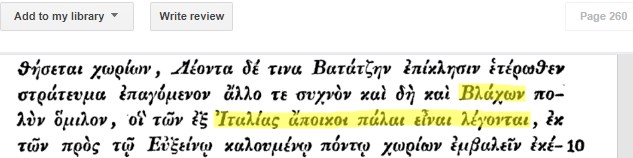
Joannes Kinnamos (or John Cinnamus, born shortly after 1143 & died after 1185) connects the Vlachs with the settlers from Italy.

Uq4ACa6.jpg

TRGGtSy.jpg

GFKJOj1.jpg
 
Last edited:
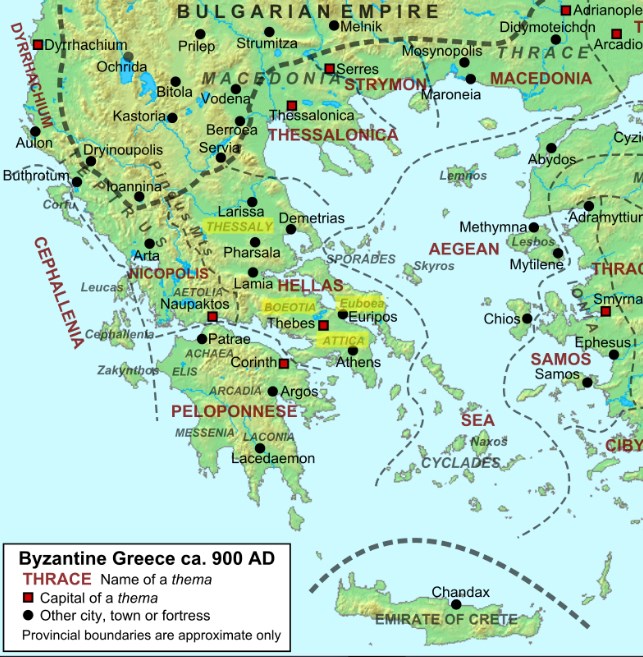
I think Hellas means Thessaly in this context.
https://en.m.wikipedia.org/wiki/Hellas_(theme)

There are a few possible meanings here, but Hellas=Thessaly in this context is likely based on an (incorrect) assumption, in my opinion, that Vlachs lived primarily/only in Thessaly.

If Kekaumenos meant Hellas=Thessaly in this context, why did he not apply the same "context" to the regions of Epirus or Macedonia as well? Why did he not use the "terms" Nicopolis or Thessalonica?

xPC4VgK.jpg


FYI - note that the Theme of Hellas included not just Thessaly, but the entirety of Boeotia, Attica and Euboea (and some smaller nearby islands). The Theme of Hellas literally touches on Corinth.

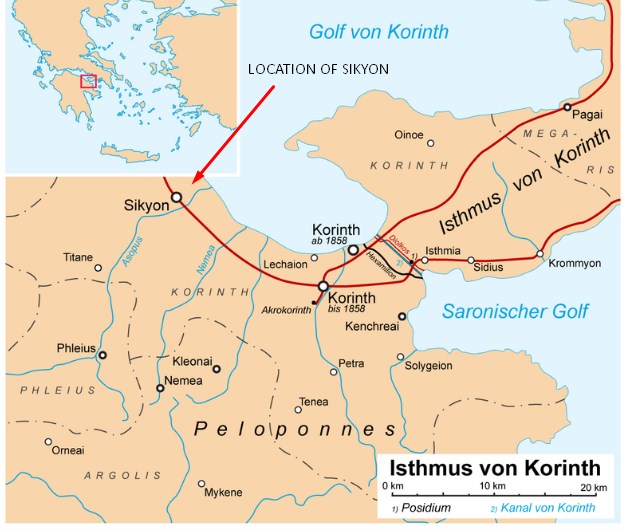
And... We have an 11th century Testimony which states that “Sikyon is in the country of VLACHIA IN HELLAS” (= Σικυών εστιν η χώρα των Ελλαδικών Βλάχων).

And famously, Sikyon is the city in Corinth region - the capital Corinth which Roman settlers rebuilt and dwelt in.
KpeKi5j.jpg


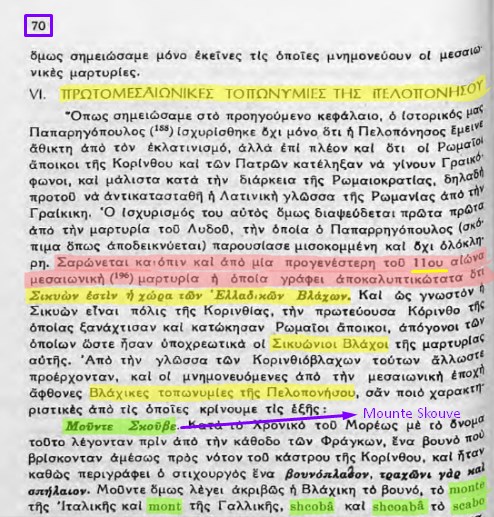
From the language of the people living there came the numerous "Vlach" toponyms in the Peloponnese, such as Mounte Skouve / Munte Skuve.
ep4dSjX.jpg


Above is Page 70 from the book "The Origins of Vlachs", by Sokratis Liakos. Original post - link:
http://www.macedoniantruth.org/forum/showpost.php?p=165215&postcount=60

Google search results for "Σικυών εστιν η χώρα των Ελλαδικών Βλάχων" in Johannes Tzetzes and Marcianus:

https://books.google.ca/books?id=J7...υών εστιν η χώρα των Ελλαδικών Βλάχων&f=false

https://books.google.ca/books?id=fX...υών εστιν η χώρα των Ελλαδικών Βλάχων&f=false
 
Last edited:
For Carlin - Look it this way Epirus and Macedonia were a part of Greece, then why did the author specify it that way. He could've said most Vlachs live in Hellas without mentioning the other part.
Now what you assumed would apply in this context eg:
Vlachs are spread over Albania but most of them live in Greece.

Could you elaborate?

Why do you think that Thessaly=Hellas?

From the wiki link you provided we can read the following about Hellas (the "boundaries" of Hellas were obviously in flux):

- During the 10th and 11th centuries, Hellas was often governed jointly with the Peloponnese under a single strategos, and as the civilian administration rose in importance, the same practice appears there as well, with protonotarioi, praetores and kritai being appointed for both themes.

- Thessaly appears to have been detached from Hellas and joined to the theme of Thessalonica from the early 11th century—though the Spercheios valley remained part of Hellas—until sometime in the 12th century.

- The strategos of Hellas is still attested for much of the 11th century, and a doux of Thebes and Euripus after the middle of the 12th century.


My basic point here is that Vlachs lived in Hellas, and the "boundaries" of this Hellas seemed to have changed over time. What did Kekaumenos mean by it? Did he mean only Thessaly? Possible, and if so, why and how was this concluded?

"Hellas" could have easily encompassed areas adjacent and/or south of Thessaly (i.e. the testimony “Sikyon is in the country of VLACHIA IN HELLAS” is a good indication of it).
 
Andreas Tzimas (Greek: Ανδρέας Τζήμας; Kastoria, 1 September 1909 – Prague, 1 December 1972), known also under his World War II-era nom de guerre of Vasilis Samariniotis, was a leading Greek Communist politician, best known as one of the leading triumvirate of the Greek People's Liberation Army during the Axis occupation of Greece. After the war, he fell into disfavour and died in obscurity in exile in Prague.

URL:
https://en.wikipedia.org/wiki/Andreas_Tzimas

- The eldest of four children, Tzimas was born to the family of Dimitrios Tzimas, a Vlach jurist and lawyer from Samarina. His mother, Ourania Alvanou, came from Moschopolis in what is now Albania. Born in Kastoria, Tzimas spent his first years in Skopje, where his father had moved, until the Balkan Wars led the family to relocate once more to Kastoria, which now had passed from the Ottoman Empire to the Kingdom of Greece.

- He was imprisoned in the Akronauplia prison, where he remained until after the German invasion of Greece. He was released by the new German authorities on 1 July 1941 due to the intervention of the Bulgarian government, which sought the release of any prisoners of Macedonian descent, who were deemed to be pro-Bulgarian. Although not a Macedonian himself, Tzimas spoke the language, and managed to be released as well (along with a few others like him).

- Despite his distinguished role in the Greek Resistance, after liberation he fell into disfavour with the party establishment: his failure to be elected to the Central Committee in 1945 was followed by his arrest and exile to Ikaria.
 
URL:
http://web.rgzm.de/en/exhibitions-e...dence-from-rescue-excavations-in-arcadia.html

The Slavs in the Peloponnese: New evidence from rescue excavations in Arcadia

Vortrag von Dr. Demetrios Athanasoulis (Athen)

Within the years 2009-2010, the former 25th Ephorate of Byzantine Antiquities conducted numerous rescue excavations in the prefecture of Arcadia during the construction of a new national road crossing the Peloponnese. This public project was an opportunity for new archaeological investigations concerning the unknown settlement history in the Peloponnese during the Dark Ages and the Middle Byzantine Period.

Among the most interesting discoveries were two cemeteries of the 7th-9th/10th c., consisting of pits with cremation urns, being undeniably a burial custom linked with Early Slavic populations and reflecting the migration and installation of the Slavs in the very south of the Byzantine Empire. In particular, in one of the cemeteries appeared graves with inhumations next to traditional cremations, reflecting furthermore the process of the Christianization of the Slavs during the Middle Ages. Slavic burial practices were also detectable in a Christian cemetery of the Byzantine period by the presence of a cremation urn among the inhumations, but also by finds of slow wheel made pots in some of the graves.

These unique archaeological findings were the starting point to establish a research group to examine the still unknown Slavic culture of the Byzantine Peloponnese. Aim of this lecture is, to give an insight into the current state of this research.
 
Last edited:
Thanks mate. I also came across that village name on Google as soon as I searched for Salesi. So many skeletons in the closet of our Southern neighbours.
 
:thumbup:

Salesi is just one village, one example.

The whole of Attica was an Arvanite province. According to George Finlay (in 1861) "Albanian colonists now occupy all Attica and Megaris, with the exception of the towns of Athens and Megara, where they form only a portion of the population." Furthermore, in the book "Greek Dress: From Ancient Times to the Early 20th Century" by Iōanna Papantōniou it says that "...costume in Attica was therefore associated with the Arvanites..."

Also, a report from 1820 explicitly states that one third of Athens and much of Attica spoke Albanian. :biggrin: So many skeletons it is starting to look like Coco.
 
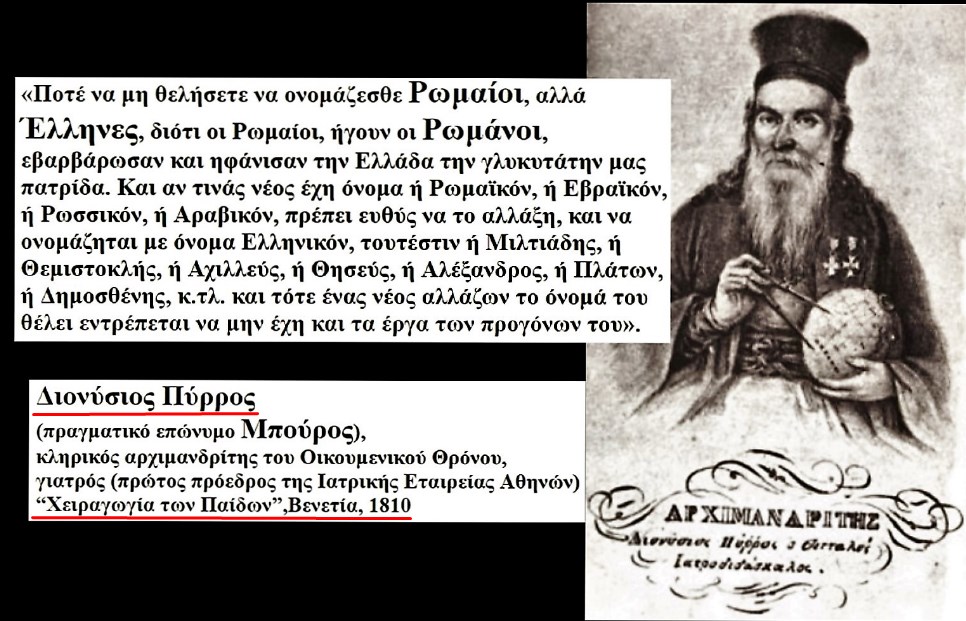
Dionysios Pyrros, Venice 1810

WzG9Hjm.jpg


"You may never want to call yourself Romaioi, but Hellenes, because the Romaioi, that is, the Romanoi, barbarized and made Greece (their?) home. And if you have a new name that is Roman, Jewish, Russian, Arabic, you must change it to a Hellenic name, namely Miltiades, Themistocles, Achilles, Theseus, Alexander, Plato, Demosthenes, etc..."


[Romaioi = Romanoi = Romans]
 
Last edited:
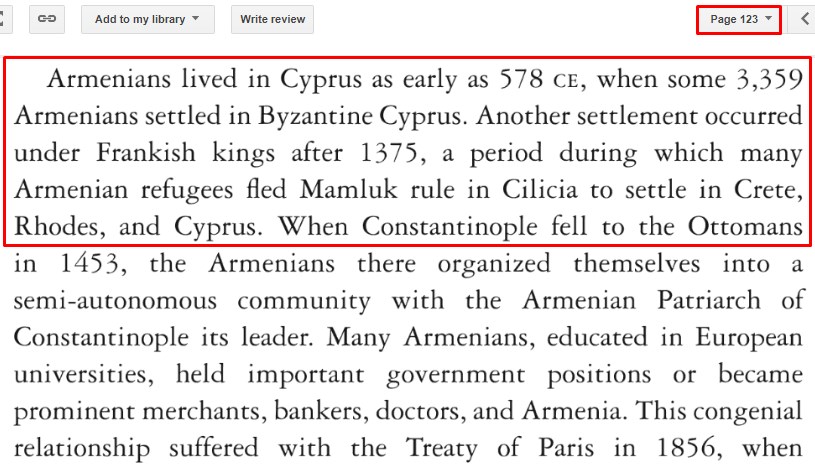
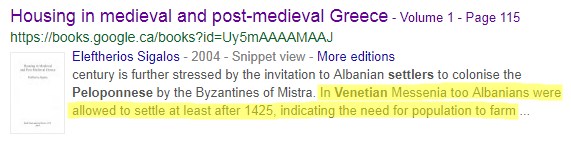
1) Armenian Mekhitarists built a monastery in the Peloponnese

URL:
https://en.wikipedia.org/wiki/Mekhitarists

"In 1700 Mekhitar went to Istanbul and began to gather disciples around him. Mechitar formally joined the Latin Church, and in 1701, with sixteen companions, he formed a religious institute of which he became the superior. They encountered the opposition of other Armenians and were compelled to move to the Morea (Peloponnese), at that time Venetian territory, where they built a monastery in 1706."

2) ARMENIANS IN CRETE

URL:
https://www.facebook.com/1393365294...l-glance-about-the-armenian/1440907399285043/

"THE ARMENIAN PRESENCE in the island goes back to 961, when the Byzantine Emperor of ARMENIAN descent, Nicephoros Phocas liberated Crete from the Arab conquerors. The deed was realized with the help of thousand of soldiers of the Armeniacon Thema, the military bases on the borders of Armenia. After completing the mission, the Armenian soldiers made roots all over the island, giving their native country's name to villages (Armeni, Armenokhori, Armenogeia), to summer places (Amari), to different sites (Armenocambos, Armenopetra). Their influence was extended to the architecture, to the vocabulary, to the dress and the preference of black colour, to the boots and head cover, even to some habits as the use of weapons during feasts, the artcraft of Armenian knifes, the vengeance."

3)
7A9HP35.jpg

9j2YJ6n.jpg
 
Last edited:
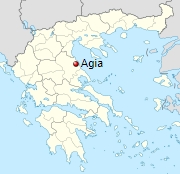
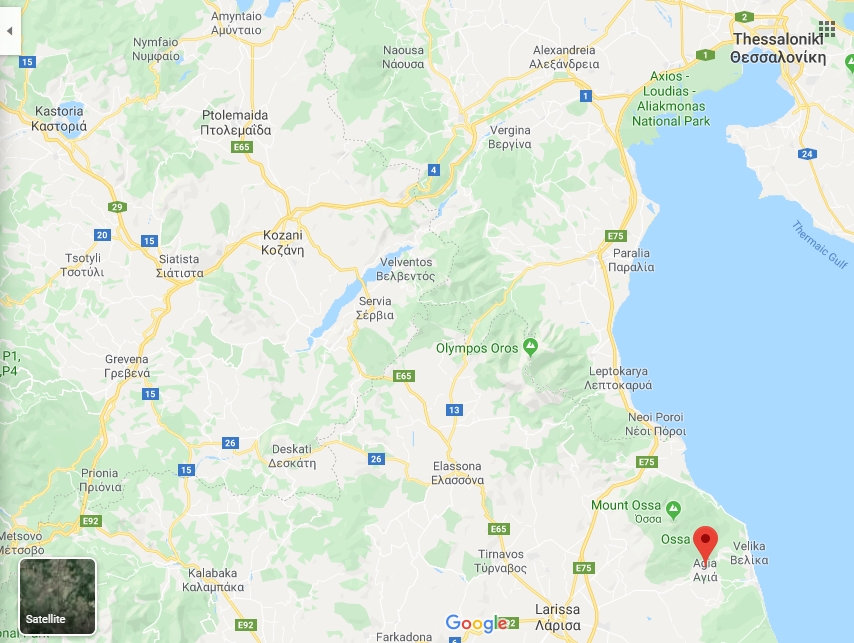
Agia (Greek: Αγιά, also written Ayia) is a village and a municipality in the Larissa regional unit, Thessaly, Greece. Agia is located east of Larissa and south of Melivoia. The Mavrovouni mountains dominate the south and the Aegean Sea lies to the east.

https://en.wikipedia.org/wiki/Agia,_Larissa

reyOXxx.jpg

IX0dQTM.jpg


URL:
https://webcache.googleusercontent....+&cd=1&hl=el&ct=clnk&gl=gr&client=firefox-b-d

In the Ottoman census of the year 1455 of the Agia village there are last names like Servos (one full name is recorded as 'Ivanis Servos'), Slavos, Bratois, Kravanidis, Kraslavos, Gaikos, Suhias, Vuikos, Nenadas, Staikos, Stoviravos and others.

Also there are first names like Ivanis, Dobros, Traikos, Milos, Vlados, Stoianos, Nenadas, Vetikos, etc. Widow Mila, widow Petrana, widow Vlasina, widow Dobrina and many more.

(There are also a few last names such as Vlachos, Arvanitis, Moraitis, Muzakis.)


Some examples of full names:
- Dobros Moraitis
- Stoianos Moraitis
- Ivanis Servos
- Vetikos Servos
- Staikos Servos
- Magos Servos
- Staikos Dermanos
- Nikolas Arvanitis
- Nenadas Arvanitis
- Gazos Arvanitis
- Ginis Vlachos
- Traikos Leontaris
- Giorgos Zagorinos
- Purdanos Kraslavos
- Thodoros Velikas
- Vlados Vlasis
- Ginis Nenadas
 
Last edited:
Back
Top